Accomplice Ability Adjustments:
Big Nose Nick: Removed Duel Immunity. Now, "You may discard any card from your hand as a BANG! during a Duel." Thus, cards are still depleted during the Duel, even though the person possessing Big Nose Nick has a high probability of winning the Duel.
Ellie Cashman: Simple indicator adjustment, as well as shift from "next turn" to "next draw phase" activation to avoid possible Jail confusion. Now, "If you do not play or use any cards during your turn, you may draw an extra card at your next draw phase. Rotate this card vertically to indicate you will draw an extra card."
Debating over Adjustments:
Albert Boothwell: His ability has read thus, "Once on your turn, you may discard a card to disable a card in play. Flip it face down to show it is disabled. While disabled, the card cannot be used or utilized. On his turn, that card's owner may discard a card to enable it." With more thought, this ability appears to be very powerful, especially depending on turn order. The card disabled is out of play until the affected player's next turn, in which he can get pummelled by you and your allies if it was an essential defensive card (Mustang, for instance). I think this is far too powerful an ability for an accomplice, but how to adjust it for greater balance? Should the cost for disabling be 2 cards? Or should the disabled card's owner not have to pay any card to enable it? Or should the disabled card's owner be able to enable the card by discarding a card at any time? Or should only 1 action be able to be carried out against the disabled card's owner before the card is re-enabled? What do you think?
Lilian Smythe: Her ability reads, "Give up your draw phase to discard 1 card from the hands of 2 separate players." I don't know how often a player would want to do this; he would have to be pretty secure to give up his draw phase, and what if he draw 2.5+ cards a turn? The chances of him using Smythe's ability is quite low. The 2 separate player stipulation also makes it difficult once only 2-3 players are left alive. Thoughts? Perhaps she could forego drawing a card during her draw phase to discard 1 card from another player's hand? That way if Black Jack succeeded on his guess for his second card, he could discard instead of draw a third card, and Pixie Pete/Bill Noface wouldn't be negatively affected.
Jay Bryant: His ability reads, "At the start of your draw phase, call a suit. If any cards drawn are that suit, you may pass 1 with that suit to another player. You must show the card to verify it is of the called suit." My question is whether or not Jay's owner should have to show the card to verify the suit, or simply show the card's suit (masking the rest of the card with his hand/another card if he wanted)? What do you think?
Grue Duck: His ability reads, "If you play a BANG! at a player whose gun range is less than yours, that player cannot play, use, or "draw!" any spades or hearts to avoid your attack." I like using the gun range numbers against each other, but is his ability too powerful or too useless? Should a scope/binoculars augment "gun range," since technically the cards only refer to sight?
Sally Skull: Her ability reads, "Once a turn, you may lose a life point to negate the effect of a card just played or used." Must Sally do her negation immediately when the card is played, or can she witness what its outcome would be and then negate it? We could imagine her seeing what a played Indians! would do, and then choose to negate it, or simply negating it the moment it came into play. Losing a life point is a big deal, so I thought the "foresight" might make the ability more useful. But would it be too useful?
2 New Ideas:
(1) You may discard any card as a BANG! when Indians! is played.
(2) At the end of your discard phase, you set aside the card on top of the deck. This will be the first card you will draw at the beginning of your next turn, but you may look at it at any time before then. NOTE: If this is too weak, perhaps the player at the end of his discard phase could look at the card on top of the deck and choose whether it will be the first card he draw on his next turn. If he chooses that it is not, it returns to the top of the deck. But that seems perhaps too powerful.

Menu Bar
 |
 |
 |
 |
 |
 |
Wednesday, March 14, 2012


Tuesday, February 14, 2012
Character Guide: Teren Kill

Inspired by: Terrence Hill, an Italian action who starred in many spaghetti westerns.
Life Points: 3.
Ability Type: Defensive.
Ability: "Each time he would be eliminated 'draw!': if it is not Spades, Teren stays at 1 life point, and draws 1 card." It should be clarified that this moment is upon his "would be elimination," so a player can choose to play a last chance Beer and not undergo the "draw!" (see WWS FAQ Q18). However, the instruction cards explain that if a person voluntary foregoes playing the last chance Beer and "draws!" for Teren Kill's ability instead, he cannot afterwards play the last chance Beer if it is unsuccessful.
Activation: When he would otherwise be eliminated.
Cards less effective when played against by Teren Kill: Dynamite, and all damaging cards to some extent.
Cards more effective when played by Teren Kill Dynamite (he is less likely to be eliminated by its random mechanism than his peers).
Good role for Teren Kill: Renegade.
Characters that counter Teren Kill well: John Pain (for everyone of Teren's "draws!," he has a good chance of picking up a card too), Lee Van Kliff/Willy the Kid/Doc Holyday (they can easily make 2+ attacks during their turns, and so have a good chance of eliminating Teren Kill when he is down to his last life point), and most importantly Kit Carlson (he has a fair chance of stacking a spade against Teren Kill when he is at his last life point, and then attack him; if Teren has to "draw!" he is guaranteed to die).
Characters that Teren Kill counters well: Greg Digger/Herb Hunter/Vulture Sam (these characters' abilities activate upon player elimination; since Teren Kill will tend to not be eliminated easily, it makes it more difficult upon them), to some extent Pat Brennan/Belle Star (They can ignore (on Star's turn)/remove cards in play in front of Teren Kill, but it won't affect his native defensive ability, not to mention the card he draws into his hand if his "draw!" succeeds), and Slab the Killer (Slab's attack still only adds up to 1 life point lost, and so while it might blunt Teren Kill's defensive cards, it doesn't affect his ability).
2-player value: Excellent. His life retention ability will be very helpful when his opponent can no longer utilize Beer to regain life points.
General Strategy as Teren Kill: Teren Kill's ability gives him a 75% chance of remaining alive and drawing a card when he would be eliminated. The "drawing!" for this outcome does interact with event cards (Curse causing his immediate demise) and characters abilities (John Pain's, for instance). Of course, when Teren Kill is attacked in succession during another player's turn, his chances of survival are above 75% on the whole. The "draws!" probabilities remain relatively the same (the "drawing!" mechanism never gives a perfect a priori probability due to it only applying to the values of the cards remaining in the deck, so it is different from rolling a 4-sided die; cards in play are not reshuffled back into the deck until discarded, also changing probabilities), but the card drawn by Teren Kill upon a successful "draw!" increases his chances of survival. Thus, he could gain a card that can ward off BANG! or Indians!, or gain a Beer to play in a last chance sense. If a card takes off 2+ life points, Teren Kill does not have to "draw!" for each life point, just once. See Q12 of the Wild West Show FAQ:
Q12. If Teren Kill is eliminated by Dynamite, how many times does he have to "draw!" to stay alive? A. Just one time; if it is a card of Spades he is out, otherwise he stays at 1 life point (and draws a card from the deck).While this defensive ability is quite powerful, it does have an irritating side to it: it only activates as a "last resort" before elimination. Any moment before then, his ability has almost no application. And he doesn't want to intentionally lose life points to use the ability since this move affects his card limit. He, of course, will try to build a hand and get cards in front of him that don't require him to use his ability. This, in essence, makes his ability pretty boring until he gets to his last breath, and it could still be boring if on his first "draw!" he gets a spade. If he survives, he has a fair chance of recovering another life point with likely having 3-4 cards in his hand at the beginning of his next turn. This make the card limit issue slightly less problematic. There is one exception to the Teren Kill's rather bland gameplay: Dynamite. Teren Kill should try to play it whenever possible. Since the chance of it exploding on him and eliminating him is quite low in proportion to the other players, and the damage it inflicts on others is so great, Dynamite is Teren Kill's best friend. Of course, this works far less effectively if Teren has to worry about blowing up his team mates, so he should consider the mix of player roles.
Playing against Teren Kill: Teren Kill is not a powerful character in an offensive sense. With a defensive ability that only activates upon his nigh elimination, and a 3 card limit, it is relatively easy to knock down his life points/card limit. But that shouldn't make you suppose that Teren Kill is weak. His stubborn persistence to live makes the battle with him one of attrition. His weaker offensive edge can still take you in the end if you do not put him down. However, since he is weaker offensively, you might consider ignoring him until you can eliminate one of his easier-to-off allies. If Teren Kill is Sheriff and you are an Outlaw, this does lead to a bit of a conundrum: do I still try to make a strong offensive burst at Teren Kill with my fellow outlaws, or do we try to knock out the Deputies/Renegades first? This is a toss up, but the tide of the battle is seriously against you in 7-8 player games (with 3-4 other non-Outlaws). The burst may be the only viable option, even though it would be extremely lucky for it to succeed. In a 6 player game, things are different. However, if Teren Kill is not the Sheriff (say, an Outlaw), eliminating his allies first makes far more sense.
Whether or not you ignore Teren Kill momentarily, watch out for when Dynamite is in play. This card has a lot higher chance of doing damage to you/your allies than it does to Teren Kill. In most cases, you will want to steal, discard, or otherwise remove it from play, so that your team's position isn't compromised.
Once you focus on Teren Kill, apply the same general offensive strategy until he gets to his last life point. Teren Kill will try to compensate during early-mid game by building up some defensive cards in his hand and in play (Mustang, Barrel, etc.). Use steal/discard abilities and cards to remove the defensive stronghold and pummel him down to his last life point to decrease his card limit. To finally eliminate him, chances are that a strategically orchestrated attack is necessary. This means either that you and your teammates attack him in succession before he has a turn, or that you can hit Teren Kill with an offensive combo, so that he has to "draw!" to keep his life multiple times. Of course, desperate times call for desperate measures, so this ideal orchestration may not be a feasible reality. Just keep shooting, then! Odds should require you to only make him "draw!" 4 times, but you can never tell. The battle with Teren Kill could be epic, or laughable (he "draws!" a spade the first time).
Monday, November 21, 2011
More Accomplice Ideas
I have finished a few more ideas for accomplices. This is just the initial phase where I try to only strike down ideas that clearly don't work. General balancing of them will take some time.
As for production, I am tempted to make it an 18 card deck, but have another accomplice on the card backs. This maximizes the printing value. Thoughts? Can you see any problems with doing it this way? Will someone try to cheat and switch their accomplice mid-game? But someone call always try to cheat if they wish and this seems like a less plausible way of doing it (more likely to get caught). Anyway, here the new ideas are below:

As for production, I am tempted to make it an 18 card deck, but have another accomplice on the card backs. This maximizes the printing value. Thoughts? Can you see any problems with doing it this way? Will someone try to cheat and switch their accomplice mid-game? But someone call always try to cheat if they wish and this seems like a less plausible way of doing it (more likely to get caught). Anyway, here the new ideas are below:
Sunday, November 20, 2011
Valley of Shadows: Group Shipping Order to the USA
EDIT (03/14/2012): Order has still been stalled due to Martin Blazsko (Valley of Shadow's designer) not giving me a correction of my translation and not giving me information on possible group deal pricing with ALBI. Sorry, this has been out of my hands.
EDIT (02/15/2012): To receive your own deck, e-mail me at martinpulido2@gmail.com with your physical addresses. That will allow me to calculate the cost of shipping to your address from my location after I receive the decks from Martin Blazko, and thus the total cost. Thus, your cost is: Cost of Deck(s) + (# of Decks you want)/20 of international shipping cost + local US shipping to your house + any additional optional fees (stickers, sticker placements). Payment can be done 1 of 2 ways: via money order, or by "donating" to me via PayPal (bottom near the top of the right hand column of this website). Of course, do not pay until you know the total cost. Thanks!
The official Czech expansion to BANG!, Valley of Shadows, has been out for a couple of months now. Unfortunately, the publisher only ships to the Slovakia and the Czech Republic. I have been talking with the expansion designer, Martin Blasko, to ship some over to me in the United States. The expansion costs $7+shipping, which will be determined by the amount of decks shipped. I am hoping to get a group order on this; it will help cut down on the costs of international shipping. The plan will basically be to get a bunch of people committed to get decks of Valley of Shadows. We will divide the costs of shipping. I will pay for the whole order and have them all shipped to my address, but only after people have donated their share of the cost to me via Paypal (look at the Donate button on the right hand column of the site). After the decks are shipped to me, I will ship them on to the rest of the group.
I have revised the English translation of Valley of Shadows with Martin Blasko. I plan to have this translation printed on stickers that can be applied to the Czech cards. You can do this yourself when you get your deck, or if you donate an extra buck or so, I will apply the stickers to the cards for you before I ship them to you. Any interested parties?
EDIT (02/15/2012): To receive your own deck, e-mail me at martinpulido2@gmail.com with your physical addresses. That will allow me to calculate the cost of shipping to your address from my location after I receive the decks from Martin Blazko, and thus the total cost. Thus, your cost is: Cost of Deck(s) + (# of Decks you want)/20 of international shipping cost + local US shipping to your house + any additional optional fees (stickers, sticker placements). Payment can be done 1 of 2 ways: via money order, or by "donating" to me via PayPal (bottom near the top of the right hand column of this website). Of course, do not pay until you know the total cost. Thanks!
The official Czech expansion to BANG!, Valley of Shadows, has been out for a couple of months now. Unfortunately, the publisher only ships to the Slovakia and the Czech Republic. I have been talking with the expansion designer, Martin Blasko, to ship some over to me in the United States. The expansion costs $7+shipping, which will be determined by the amount of decks shipped. I am hoping to get a group order on this; it will help cut down on the costs of international shipping. The plan will basically be to get a bunch of people committed to get decks of Valley of Shadows. We will divide the costs of shipping. I will pay for the whole order and have them all shipped to my address, but only after people have donated their share of the cost to me via Paypal (look at the Donate button on the right hand column of the site). After the decks are shipped to me, I will ship them on to the rest of the group.
I have revised the English translation of Valley of Shadows with Martin Blasko. I plan to have this translation printed on stickers that can be applied to the Czech cards. You can do this yourself when you get your deck, or if you donate an extra buck or so, I will apply the stickers to the cards for you before I ship them to you. Any interested parties?
Saturday, November 19, 2011
Accomplices Expansion
News (11/21/11): Rewrote character drafting rules, hoping to bring more clarity. Diagrams will be provided later.
News (11/20/11): Revised how the extra cards are stored up in the character drafting; they now are put into play before the game has even begun. Blue cards are self-explanatory. Brown, purple, and orange cards will function like green cards for simplicity's sake.
News (11/20/11): Revised how the extra cards are stored up in the character drafting; they now are put into play before the game has even begun. Blue cards are self-explanatory. Brown, purple, and orange cards will function like green cards for simplicity's sake.
I have been working on another short expansion to BANG!. My first expansion, Death Mesa, worked on the player elimination aspect to the game. My second, Robbers' Roost, worked on player interaction and increased gameplay out of turn. This third expansion has a simpler goal: increasing the variety of the game and changing the way characters are distributed at the beginning of the game.
The main way that I hope to do this is through introducing "accomplices" to the game. An "accomplice" is like a character in having a special ability. However, this ability is far weaker, and the accomplice also has no life points. Each player receives an accomplice paired with a character, the accomplice's ability compounding with the main character. This allows for many interesting combinations of abilities that will provide players with no ways of experiencing the game. I have decided what I want to call these "accomplices": accomplices (of course), helpers, followers, partners, companions, henchmen, or cohorts. You will have to tell me your thoughts.
I have created a more unique look for the accomplices. Their cards are oriented horizontally, and the art flows over the card, instead of being in a box in the top center. I haven't nailed down exactly how I want them to look, but this is what I am working with so far. Below is 10 accomplice examples, with some abilities I am considering to include.

The difficulty has been of course to identify abilities that are useful, but not too useful. Also, I have to make sure that no combinations are too powerful, contradictory, or superfluous. For instance, it would be stupid to have an accomplice that allows you to play an Ace as a Missed! If that accomplice was paired with Elena Fuente, she would have no extra bonus. To help balance the fact that some pairings will work better than others, I have created a new character drafting method, which is largely based upon the method of picking races in Small World.
(1) The appropriate roles for the number of players are randomly dealt. The Sheriff reveals his role; the others remain hidden. The playing card deck is shuffled.
(2) The character and accomplice decks are both shuffled. Reveal 4 characters at random and lay them face up in a single column. Place the remaining characters face down, in a single stack, at the bottom of the column. Do the same with the accomplices, placing one to the left of each revealed character. Stack the rest of the accomplices in a pile face down to the left of the character stack. You should now have 4 character and accomplice combos face up on the table.
(3) A player is selected to go first. Have all players guess a card's alphanumeric value (2-10, J, K, Q, or A), but not a card's suit. "Draw!" the card on top of the playing deck. Whichever player is closest to the "drawn!" value goes first. Put the "drawn!" card in the discard pile.
(4) That player selects one character and accomplice combo, from among the 4 visible on the table. The cost of each combo is determined by its position in the column. The first combo, located at the top of the column, is free. Each of the other combos, as you move in succession down the column, cost 1 additional playing card. That cost is paid by the player dropping 1 of the playing cards (that he would typically start the game with) face down to the left of each of the combos situated above the combo he wishes to pick. These cards are provided from the playing deck.
If the combo a player selects contains some playing cards (dropped by players who previously passed up this combo), the player pockets these cards. He must still drop 1 of his own playing cards on each of the combos located above the one he selects (if any), however.
(5) The player places his combo selection in front of him. Any cards he gained through the combo selection are put into play in front of him. Since these cards may be brown, orange, or purple cards, such card colors when put into play are considered green cards. Their effects may be stored up to be used in or out of turn as the effects dictate.
(6) The player draws playing cards from the deck equivalent to his life points minus any cards he expended on character and accomplice combo selection.
(7) Finally, the player replenishes the column of combos available to others. He slides existing combos (and the playing cards to the left of them, if any) up one position in the column, so as to fill the void, and reveals a new combo from the top of the stack, if appropriate. There should thus always be 4 combos visible to all players, on the table.
When every player has selected a character and accomplice combo, remove all remaining characters and accomplices. Remaining playing cards spent for combos are put into the discard pile for playing cards. The game then begins with the Sheriff's turn, and proceeds like usual.
One thing I also like about this expansion is that it is easily made with a POD. The unusual size of the accomplices won't matter since they are their own set of cards, much like the Dead Men's Deck in Death Mesa. Any feedback on this accomplice idea?
Wednesday, November 16, 2011
Revised Robbers' Roost Guidebook Available

I completely recreated the Robbers' Roost Guidebook. It now has the most up to date information on the rules for the orange and purple modules. I have added several examples of how orange cards are resolved and played in different situations. The Guidebook also contains detailed explanations of the new and revised playing cards and characters. I have addressed questions about how to play certain Robbers' Roost cards in specific scenarios, as have been asked in the forums. Besides this, I have added a new method of production. Finally, there have been a few tweeks to some playing cards and characters (Jack West--now named Pat Barrett, Laura Billion, Lela Devere, Porter Rockwall, and Confiscate). The 8.5" x 11" playing card sheets have been reuploaded with these adjustments.
Now that I believe I have adjusted a little more to being a new parent, I should be able to dedicate some more time to the BANG! Blog. I am excited to get the RR POD out, as well as write more on Gold Rush, Valley of Shadows, and the multiplayer, multicross-enabled BANG! video game. Expect more posts soon!
Friday, November 11, 2011
Gold Rush: BGG Interview with Roberto Corbelli @ Essen Spiel 2011
The following interview with Roberto Corbelli lets you see a lot of the pieces inside the upcoming Gold Rush expansion. Corbelli explains how Gold Rush adds economics to BANG! with the gold nuggets and equipment cards they card purchase. He runs through the rules that are in the expansion, as well as the Shadow Gunslinger Variant. At the end of the interview he reveals that Gold Rush will be available in the United States at the beginning of next year. Just a 1000 printing run had been made for the conference. Of interest, he shows all of the character cards. I zoomed in on the video, and have the English for all of the character abilities:
Simeon Picos: Each time he loses 1 life point, he takes 1 gold nugget.
Raddie Snake: During his turn, he may discard 1 gold nugget to draw 1 card up to 3 times.
John McCloud: He may draw the top equipment card from the deck by discarding 2 gold nuggets.
Jacky Murieta: During his turn, he may pay 2 gold nuggets to play an extra BANG!
Madam Yto: Each time a Beer card is played, she draws 1 card from the deck.
Don Bell: At the end of his turn, "draw!" If Hearts or Diamonds, he plays an extra turn.
Dutch Will: He draws 2 cards, discards 1, and takes 1 gold nugget.
Pretty Luzena: Once per turn, she may buy any 1 equipment at a cost reduced by 1 gold nugget.
Friday, October 21, 2011
Character Guide: Youl Grinner
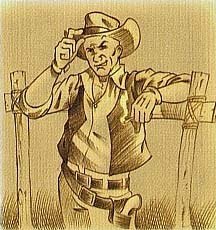
Character Name: Youl Grinner.
Inspired by: Yul Brynner, famous actor best known for his role as Mongkut in The King and I. However, he acted in numerous westerns, such as when he portrayed Chris Adams in The Magnificent Seven.
Life Points: 4.
Ability Type: Neutral, although its power offensively/defensively will depend on his playing style and those of other players.
Ability: "Before drawing, players with more hand cards [cards in their hand] than him must give him one card of their choice."
Activation: Before other players' drawing phases, after they resolve Dynamite, Prison, and event cards.
Cards enhanced by Youl Grinner's ability: non-BANG! attacks besides Indians!/Duel (as he can quickly play them during his turn to drop the amount of cards in his hand), green defensive cards (Sombrero, Iron Plate, Bible, Ten Gallon Hat), Canteen, Barrel, Mustang, and Hideout. General Store can be great in helping increase the amount of cards in others' hands.
Cards weakened by Youl Grinner's ability: Duplicates of cards in play and defensive cards that remain in the hand (Missed!, Dodge), as he cannot voluntary play them to drop the amount of cards in his hand. Gatling and Indians! can still be powerful attacks, but by often lowering the amount of cards in all other players' hands, he may be weakening his leaching ability.
Cards less effective when played against Youl Grinner: Steal and discard cards targeting his hand (Panic!, Cat Balou, Can Can, Brawl, Rag Time, Conestoga).
Ideal role for Youl Grinner: All. As a Renegade it doesn't often matter whose cards he steals, as a Sheriff he can get hooked up from his Deputy with great cards, and as an Outlaw he will almost always being syphoning off cards from the Sheriff who tends to have more cards in his hand (5 life point character usually).
Characters that counter Youl Grinner well: Pat Brennan (he can steal cards Youl Grinner and others have in play instead of drawing cards, allowing him to control his the amount of cards in his hand well), Suzy Lafayette (she can pass on cards creating hiccups in her chain-drawing ability--typically, Missed!, to draw many more cards during her turn), Bill Noface (his ability is maximized by starting his turn with fewer cards in his hand due to card/life point constraints and then picking up a lot during his drawing phase; he may be able to mostly avoid giving cards to Youl Grinner), Willy the Kid (ability to dispose of BANG! makes it hard for Youl Grinner to have fewer cards in his hand than Willy the Kid; however, it does make it hard for Willy the Kid to store up BANG!), Sid Ketchum/Doc Holyday (transmutable abilities allow them to drop down the amount of cards in their hands), Lee Van Kliff (depleting BANG! to replicate cards in his hand helps drop the amount of cards in his hand), and Teren Kill (living on the edge ability makes it unlikely for Youl Grinner to steal cards from him).
Characters that Youl Grinner counters well: Sean Mallory (storing up cards for his card limit benefit makes it so that he will likely always have to hand cards over to Youl Grinner), Big Spencer (if he can store up cards due to his amount of life points, chances are he will always have to give cards to Youl Grinner while his life points are high; however, since Missed! are worthless to him, Big Spencer can pass those on easily in some occasions), Jesse Jones (if he uses his ability against Youl Grinner, Grinner has fewer cards in his hand, making it easier for Grinner to nab cards from others), El Gringo/Bart Cassidy (while losing life points makes them gain cards, they will likely have to hand the gained card to Youl Grinner at the beginning of their turns), Slab the Killer (who will draw Missed! from other players, and so playing 2 to avoid Slab the Killer's BANG! is both doable and beneficial for his ability), Flint Westwood (card swapping ability increases the amount of cards in his hand, making it easier for Youl Grinner to steal cards), John Pain (drawing on "draws!" makes it likely he will hand cards to Youl Grinner at the beginning of his turn),
2-player value: Excellent; the card pressure will force his opponent to use cards or pass them to him. However, his rival would be wise to pass non-efficacious Beer in their hand to Youl Grinner.
General Strategy as Youl Grinner: Youl Grinner's ability has a stronger effect on the players whose turns follow closely after his. Since he only gains cards when players have more cards in their hand than him, he will (all things being equal) be at his lowest card amount at the end of his own turn. Then, during the next couple of turns, he will pick up cards from players to his left. In larger games, players to his right may hardly feel the impact of his ability until later on in the game. This can be really good or bad for Youl Grinner depending on whether or not his allies (if he has any) are on his left or right sides. If his allies are to his left, then his team should work on making Youl Grinner their main attack force. As the store up defensive cards, they can pass on their most powerful offensive cards to Youl Grinner. Grinner can use them to deal out damage and deplete his cards to pick up more from his allies. Of course, when needed, defensive cards may also be passed.
If his rivals are to his left, he is in great position to drain them if he lowers the amount of cards in his hand. However, defensive cards may be necessary as they will hate his constant leaching. This can be best compensated by getting green defensive cards, a Barrel, and defensive sight modifiers in play. That way if he plays several offensive cards, he still has a defense if they want to quickly retaliate. Fortunately, as long as they have more cards than him, he will always get at least 1 additional card before he is attacked. He should be careful with expending all of his BANG!, though. All the cards he puts in play will do little to deflect Duel or Indians! played against him. Ideally, he should try to get down to a BANG! and a Missed! (or have a defensive card in play) by the end of his turn. This will maximize his leaching ability, while still protecting him.
With his discard/steal cards, he should likely make sure not to waste them on players with more cards than him (as he will likely steal from them anyway). Otherwise, he may end up losing the card he would have stolen from them anyway. This danger is increased when the discard/steal cards are Conestoga or Can Can. He should try to use them on players that already have fewer cards than him to compound their weaker situation.
Playing against Youl Grinner: Youl Grinner is another one of the irritating characters in Wild West Show that affects the way all other players play and manage their hands. With Gary Looter, most players could make sure that they did not exceed their cards limits, so Gary Looter tended to only benefit when people wanted to hand him cards (which works obscenely well when he is Sheriff). Of course, with both Gary Looter and Youl Grinner, players had to be somewhat careful when playing draw cards like Wells Fargo and Stagecoach. However, Youl Grinner is more irritating because you are not only monitoring the amount of cards in your hand more closely, but also the amount of cards in Youl Grinner's hand. Generally speaking, you will not want to have more cards in your hand by the end of your turn than Youl Grinner if it appears that you will have more cards in your hand them him by your next turn (turn order, as explained in the previous section affects this quite a bit).
When you do end up giving cards to Youl Grinner, look at the cards he has in play and those that you have seen him pick up/play to try to give him a less advantageous card. Also consider the card(s) you will be playing during your turn. If you are going to play an Indians! or Duel against Youl Grinner, you will probably not want to hand him a BANG! to defend against them.
In some ways, Youl Grinner's ability can be exploited. If you want a player to your left to lose a card if he has the same amount of cards in his hand and Youl Grinner, see if shooting at or discarding/stealing a card from Youl Grinner might remove a card from his hand. He may opt to take a hit instead of drop a card (or deflect it with a green defensive card or Barrel), but maybe not. Then, at the next player's turn, he will have to give a card to Youl Grinner. This could be used advantageously both as a rival or an ally of Youl Grinner.
Often with Youl Grinner, killing him is about prioritizing. Since he is leaching cards from players close to his left, think about whether or not those players are his allies. If he is a Sheriff, those other players will be of huge benefit to him, and so you may not be able to ignore them if you are an Outlaw. You might want to kill them first. Even if he is not the Sheriff, killing off his allies can be a great move. Since defensive cards will tend to sit in his hand, this can increase the amount of cards in his hand if Youl Grinner is not targetted. While a smart Youl Grinner will try to use more offensive cards to compensate, this will still make his ability activate less often. This will work even better if you adjust his sight constraints, so that he cannot easily use BANG! against his rivals. Your steal/discard cards will work well against the cards he has in play as they will not modify the amount of cards in his hand. Using a Jail on Youl Grinner when his card limit is maxed out (or the amount of cards in his hand is higher than others) can also help. After nuking out his allies, you will have to focus on Youl Grinner.
Once Youl Grinner is your direct target, you can avoid his ability in some ways. Get defensive green cards, defensive sight modifiers, and a Barrel in play, and then become more free with depleting your hand (made easier with a Volcanic). Offensive combos can also be powerful, but they have the difficulty of being stored up. If played correctly (and luckily), as Youl Grinner's life points drop, you will still tend to have in your hand less than or equal to the amount of cards in his hand.
Subscribe to:
Posts (Atom)